“…two cities have been formed by two loves: the earthly by the love of self, even to the contempt of God; the heavenly by the love of God, even to the contempt of self.”
- The City of God, Book XIV, Chapter 28, Augustine, Marcus Dods translation, 1871
“The summit of human happiness resides in the most absolute submission.”
- Submission, Michel Houellebecq, 2015
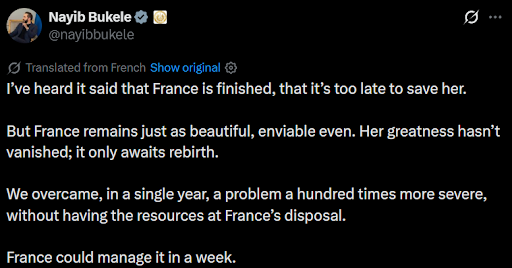
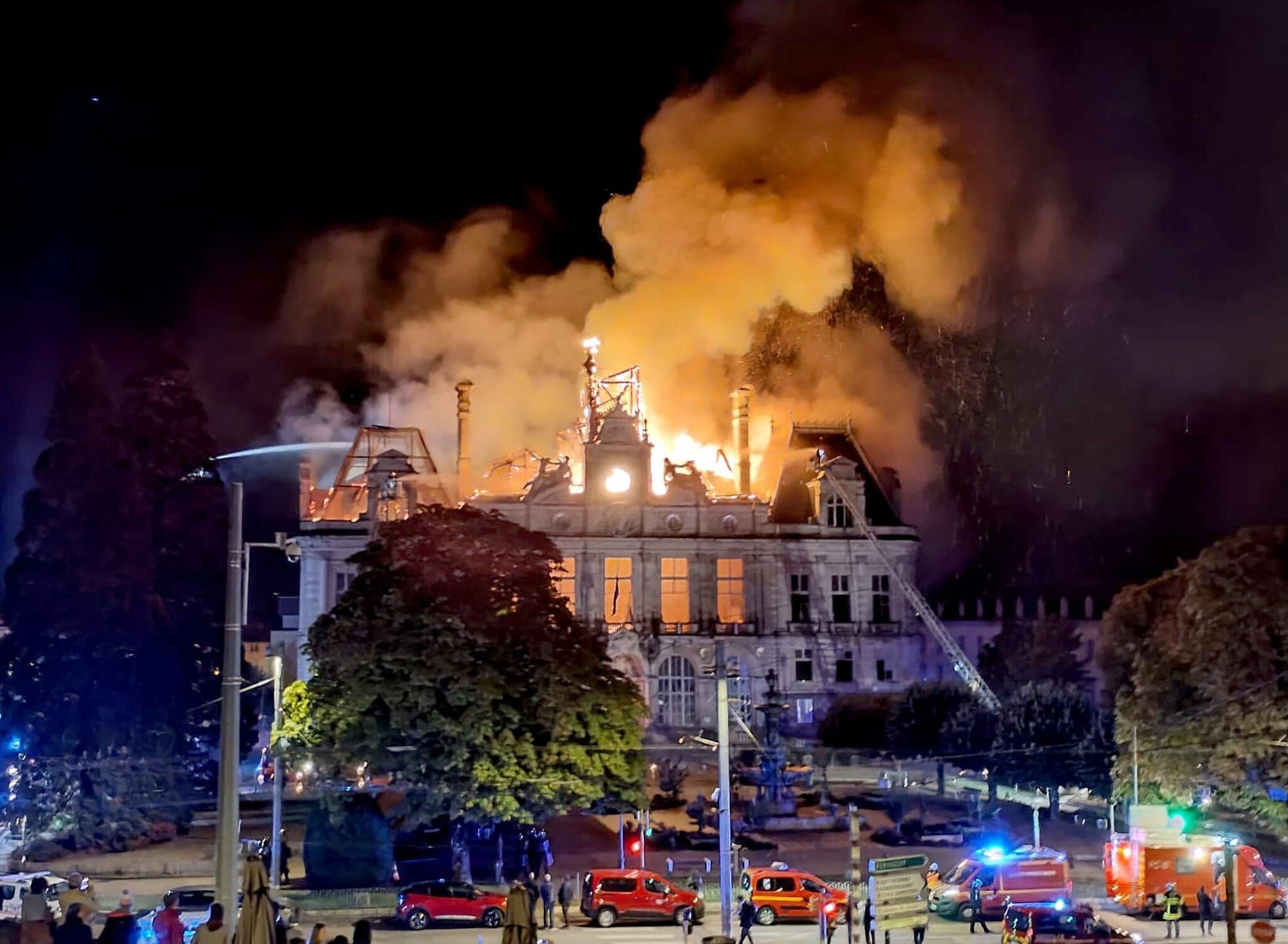
It is difficult to produce a more apt description of the animals delighting in the destruction of the Eldest Daughter of the Church than Cardinal Robert Sarah’s 2019 remark in The Catholic Herald: “The barbarians are already inside the city.” While the burning of Limoges’ city hall was not literally done to provide immediate warmth from a fire made with one’s “beautiful oak door”, as Raspail put it in The Camp of the Saints, one might consider the rhetoric of Jean-Luc Mélenchon, founder of the democratic socialist and ecosocialist LFI party, when he says that “The heart of the matter is the protesters’ demands, the problems facing students and the high cost of living”. As incredulous as one might be at the anti-civilizational radicality of the notion that centuries-old architecture, artwork, and monuments of civilization are worth destroying in order to protest, nominally, against Macron’s austerity policies, there are apparently millions of real French people who think this way. They are entirely indifferent to the iconoclasm of the edifices of Western civilization and openly hostile to its very existence.
These events are not sufficiently explained by economic factors. No civilized person, certainly no Frenchman, who grows frustrated with his ability to make ends meet decides to fashion a makeshift hijab and place it on the head of a statue of St. Joan of Arc alongside a Palestinian flag. So attention is drawn, once again, to one question: how can one reconcile the growing Muslim population with the continued existence of a French secular republic de laïcité, while hopefully eschewing a Houellebecqian submission?
Marine Le Pen, the right-wing RN party presidential candidate for the election in 2027, has been criticized for taking a seemingly weak stance on Islam, namely its theoretical compatibility with the French Republic. However, Le Pen may not have been entirely forthcoming in her statement and a consideration of what is meant by the words “Islam,” "compatible," and “Republic” may lay bare the manifest reality of the situation. Realpolitik may be a better explanation. Across the top demographic polling analysts, France’s population is roughly 10% Muslim, a number that has grown from 2% in the 21st century. According to a 2025 IFOP poll, about 40% of this population approve of Islamic fundamentalist positions, a number that has also doubled among France’s Muslims this century. According to another 2022 IFOP poll, 7% of Muslim voters chose Le Pen, while 69% chose Mélenchon in 2022. In addition to France's Muslims, there may be moderates who perhaps would not feel it conscionable to vote RN if the presidential candidate was seen as illiberal.
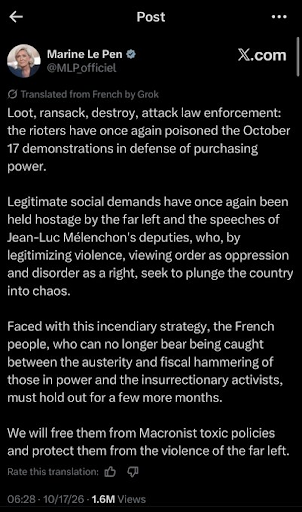
Regardless of whether one thinks Le Pen has been strong enough in her condemnation, her party is inarguably France’s strongest chance for de-Islamization. This is aided by Macron’s disapproval rating. At the moment, RN appears to have the best chances in 2027. What remains to be seen is whether the French people, in Le Pen’s words, can “hold out for a few more months.”
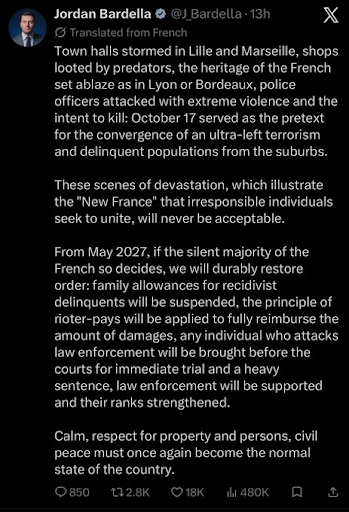
By the end of Macron’s tenure, despite his ineptitude, France will remain standing, probably without much more damage than has already transpired and probably without an ironic Houellebecqian submission to Sharia law. Despite France’s arguably de rigueur convulsions over the centuries, the recent events have had a pronounced ethnoreligious dimension. The contemporary left sees events, as it does similar recent stunts across the world, as a kind of soixante-huit redux. It sees postcolonialism as an extension of a mid-century neo-Marxist Frankfurter Schule project. To some, it is an unwelcome doctrine, prescribed by our boomer overlords for those who, ironically, are unable to think traditionally critically (see Horkheimer). Most importantly, it sees this as something separate from, or even opposed to, the liberal tolerance of France’s secular republic since its separation of church and state in 1905. From a premodern perspective, however, and despite its recent liberation theological issues a perspective represented by the Church, the contemporary left is not opposed to liberal modernity but is its continuation. In this sense, Joan of Arc’s postcolonial hijab is not in opposition to liberalism but is its logical extension. It is merely classically liberal tolerance run amok, possibly having reached some intolerably distorted final form. This is supported by the unique religious, even racial, component of recent events. Unfortunately, despite the Marcusean “clownish form” of the left having missed this simple yet important distinction, the unprecedented damage is quite real.
One then considers liberal laïcité as a cause and, further, looks to the Church for answers. When Pope Leo XIV visited France last September, he reminded us of France’s birthright as the Eldest Daughter. So, how does one reconcile the Paris of the past and the 10% Muslim population cited above we see today? It is a story of two cities, of civilization and barbarism. At present, one exists alongside the other. The barbarians are inside the city, but we can still drive them out.